A spherical body of radius  and density
  falls freely through a viscous liquid having density
  and viscosity
  and attains a terminal velocity
  . Estimated maximum error in the quantity
  is : (Ignore errors associated with
  and
and  , gravitational acceleration)


Text Solution
Verified by ExpertsA
The terminal velocity  of a spherical body falling through a viscous liquid is given by Stokes' Law:
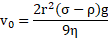 Rearranging the formula to express viscosity
  in terms of other variables:
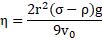 Since we are told to ignore errors associated with
  , and
, and  , these quantities along with the numerical factor
  are treated as constants.
The expression for  can be written as
  , where
  is a constant.
Taking the natural logarithm on both sides:
 Differentiating both sides to find the relative error:
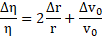
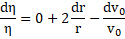 For the estimated maximum fractional error, we take the absolute sum of the individual relative errors:
Prepare Smarter with CGP Edu
Get practice questions, solutions, and test series in one place.
Write a Review
Share your experience with this question and solution.
Commentary
Send your comment, doubt, correction, or feedback to admin.
Similar Questions
Explore conceptually related problems